Investigation
Out of Office, Into the Grid: Muhammad Lutfi's Energy Gamble
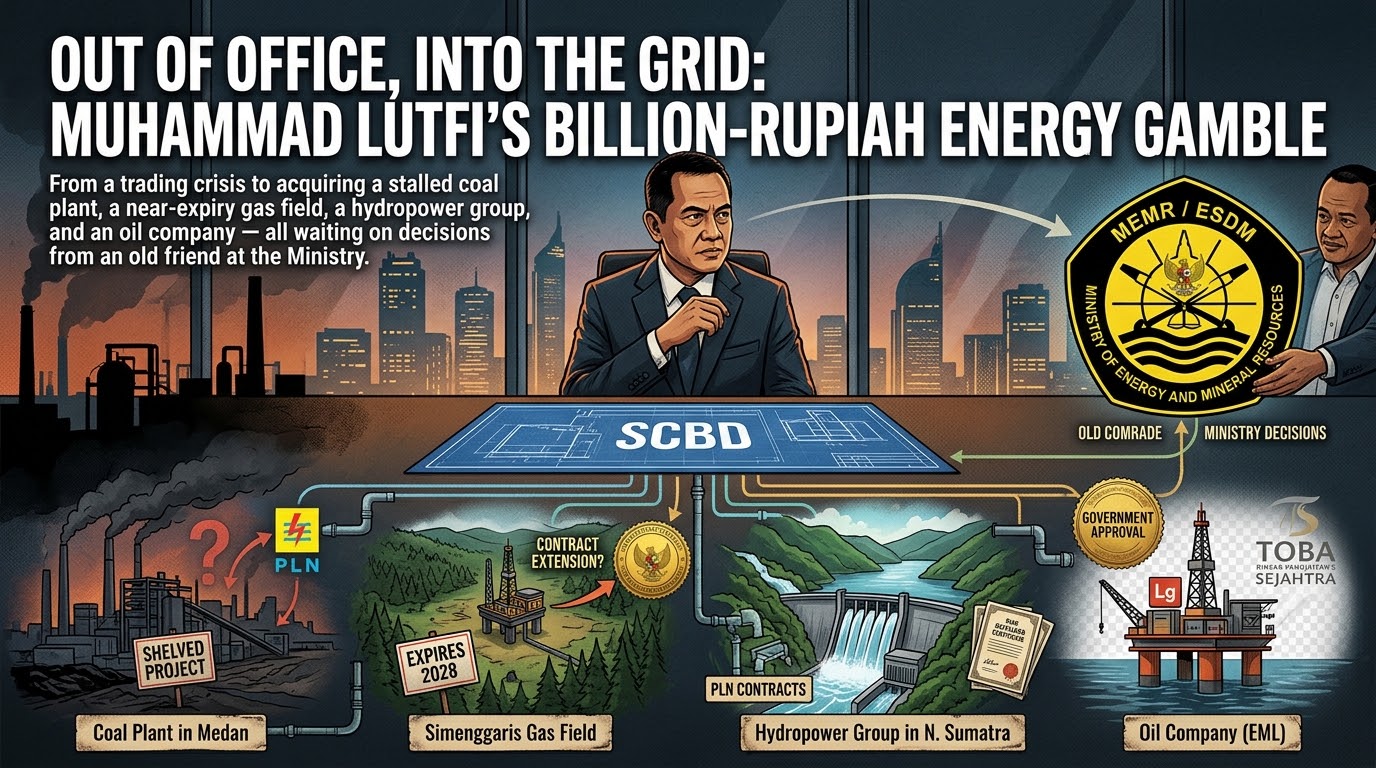
Out of office and out of the headlines, Muhammad Lutfi has spent the past year buying up energy assets that other owners wanted to be rid of: a stalled coal plant, a written-off gas field, a hydropower group and an oil company. Each will be worth far more if the energy ministry decides in their favour. The ministry is run by a man who calls Lutfi an old comrade.
When Muhammad Lutfi left the trade ministry in the summer of 2022, the country was in the middle of a cooking-oil crisis. Prices had soared and queues had formed outside shops. He was replaced in a reshuffle, and the Attorney General’s Office later questioned him as a witness in its inquiry into export permits.
For the next three years he was rarely in public view. He campaigned for Prabowo Subianto in the 2024 election, and after that he largely disappeared from the news.
He has not been idle. Since late 2025, a holding company that Lutfi controls has taken over, or taken charge of:
- a coal-fired power plant in Medan;
- a gas field on the Malaysian border;
- a group of hydropower companies in North Sumatra;
- an oil and gas company that once counted Luhut Binsar Pandjaitan’s family holding company among its shareholders.
Lutfi now sits at the head of the board of almost all of them.
The assets have something in common besides their new owner. None of them was a prize. Each came from a seller with reasons to sell: a field near the end of its contract, a stranded Chinese power project, owners cashing out. And each can become valuable only through a decision taken by the Ministry of Energy and Mineral Resources.
The minister is Bahlil Lahadalia. For two decades he and Lutfi have moved in the same circle, the Indonesian Young Entrepreneurs’ Association, HIPMI, and from 2020 to 2022 they sat in the same cabinet.
I. A holding company in SCBD
Lutfi’s business career has always run alongside his government one:
- HIPMI: he made his name as a young businessman, and chaired HIPMI in the early 2000s.
- Government: he ran the investment board and was briefly trade minister under Susilo Bambang Yudhoyono, and later served as ambassador to the United States.
- Medco: in between, he spent five years as chairman of the board of commissioners of Medco Energi, the oil and gas group founded by Arifin Panigoro.
- Back in office: in December 2020, Joko Widodo brought him back as trade minister.
His last public declaration of wealth, as a minister, put his net worth at about Rp 236 billion.
The new venture is called PT Valvorion Mandala Agung. It was registered in late 2025, on the 25th floor of an office tower in Jakarta’s SCBD business district. Lutfi owns three-quarters of it.
The other quarter belongs to Denis Ergana Gaos, a businessman of about forty who runs a small group of coal and minerals companies. Denis is the operating partner. Wherever Valvorion goes, he usually becomes the president director, while Lutfi takes the chair.
The third figure is Felly Imransyah, a Jakarta businessman whose group owns hotels, restaurants and a Bali beach venture. Felly has invested alongside Lutfi in almost every company the two have set up since 2025. Their hospitality joint ventures have drawn in other well-known names; one recent Bali venture counts the television star and presidential envoy Raffi Ahmad among its shareholders.
Valvorion itself is small. It and the two energy sub-holdings it created, both named Aureus, were each set up with about Rp 10 billion of capital. A handful of minority investors took small stakes:
- One of them was a company registered just four days before the sub-holding it invested in.
- When the paperwork was signed, Denis signed on behalf of both minority investors.
- In the gas-field vehicle, a quarter belongs to a company in the British Virgin Islands. Its director is a Canadian businessman who already invests alongside Denis in his mining, consumer and media ventures.
In other words, the outside money is not obviously outside.
II. The hydropower group
The first large acquisition came in the middle of this year: PT Mega Power Mandiri.
- It is a power producer that has held a licence to sell hydroelectricity to the state utility, PLN, since 2007.
- It is linked in forestry permits to the Wampu hydro project in North Sumatra.
- It controls a subsidiary, Mega Hydro Energi, that generates enough cash to pay its parent tens of billions of rupiah in dividends.
The group’s previous owners were businessmen around Rabindra Wisatrya, Teguh Wicaksana Sari and Djoko Susanto, whose company filings carry email addresses at Bukaka, the engineering group of the family of former vice-president Jusuf Kalla.
Before letting go, the sellers rearranged the company:
- They had its assets revalued at several times their book value.
- They turned the paper gain into new shares, and booked hundreds of billions of rupiah in fresh capital.
- They paid themselves dividends, not in cash but in property: a set of apartments in a South Jakarta tower, and land in Bogor and East Jakarta.
On paper, Mega Power Mandiri’s share capital rose almost ninefold. Then Lutfi’s sub-holding took all of it, and Lutfi became chairman of its board.
How much Valvorion paid, and with whose money, is not on the public record. Three related companies from the same group followed it into Lutfi’s hands in the months after.
The group’s value rests on its contracts with PLN. PLN’s tariffs and the terms on which it buys from independent producers are set under rules made by the energy ministry.
III. The oil company
At about the same time, Valvorion bought 80 percent of PT Energi Mineral Langgeng, a company registered for oil and gas production.
- Until recently it was owned by the BBS group from Surabaya, together with Toba Sejahtra, the holding company of Luhut Binsar Pandjaitan. Luhut is a former coordinating minister and now chairs the National Economic Council.
- Toba Sejahtra is no longer a shareholder. BBS has kept a fifth.
- Lutfi is chairman of the board and Denis is president director.
Which oil or gas concession, if any, the company holds could not be established. Upstream rights in Indonesia are granted, extended and transferred with the approval of the energy minister.
IV. A field no one else wanted
Simenggaris is a gas field in the forests of North Kalimantan, a few kilometres from the Malaysian border. Medco has worked it since 2000 in partnership with Pertamina.
It was never a large asset, and by the mid-2020s it was a shrinking one:
- Gas sales to PLN had ended.
- What was left went to a small LNG plant nearby.
- The production-sharing contract expires in February 2028.
In 2024 Medco’s board decided to sell, and over the following year the company wrote down the field’s value. By the end of 2025 Medco’s own accounts valued its oil and gas assets at Simenggaris at nothing.
In early 2026, Medco signed a conditional agreement to sell the company that holds its interest. In the same weeks, Valvorion and its BVI partner set up a new company to own it. The deal closed in the middle of the year.
Medco mentioned the sale only in the notes to its half-year accounts. It did not name the buyer.
The new board of PT Medco E&P Simenggaris:
- Muhammad Lutfi, chairman;
- Felly Imransyah, commissioner;
- Denis Ergana Gaos, president director;
- a second director whose company records describe him as an employee of a state-owned enterprise.
Which state company employs him, and whether his employer knows of the position, could not be established.
Whatever the buyer paid, it is unlikely to have been much. A field with two years left on its contract is worth only the gas it can sell before the deadline, less the cost of shutting it down. Extended for another twenty years, it is worth a great deal more.
The extension is granted by the energy minister. Under the ministry’s rules, a contractor that wants one must apply at least two years before the contract runs out. For Simenggaris, that deadline fell in the same weeks the sale was being agreed.
Whether anyone applied, and what has happened to the application, is not public.
V. The plant in Medan
The most visible of Lutfi’s new holdings is also the most troubled.
- The project: PT Mabar Elektrindo was formed to build a 300-megawatt coal-fired power plant in Medan’s industrial estate. Construction began more than a decade ago and stalled.
- The owners: its majority shareholder is China Oceanwide, a Beijing conglomerate whose debt was cut to junk in 2020 and which has since been selling assets. A Shanghai state-owned construction company and a local partner hold the rest.
- The tracker: the plant appears in international coal-plant trackers as shelved.
This autumn, without any change in the shareholding on paper, Mabar got a new board. Lutfi is president commissioner and Denis is president director, and two more of Valvorion’s people sit alongside them. In the company’s latest filing, China Oceanwide’s own entry gives a Valvorion email address as its contact.
Whether Valvorion is managing the project for its Chinese owners, preparing to buy them out, or something else, Mabar has not said.
A coal plant in Medan is worth something only if PLN buys its power. That depends on PLN’s ten-year electricity plan, which the energy ministry approves, at a time when the government has pledged to its climate-finance partners to phase down coal power.
VI. The minister
Bahlil Lahadalia was born in Maluku and grew up in Papua. He worked as a bus conductor before making his money in Papuan construction and mining, and rose through HIPMI to become its chairman in 2015.
He has never hidden his debt to the association, or his regard for its earlier leaders:
- Stepping down, 2019: when he left the HIPMI chair, he listed former chairmen he thought fit to be ministers. Lutfi was on the list.
- Cabinet, 2020: when Lutfi joined the cabinet the following year, Bahlil, then head of the investment board, told reporters that Lutfi, Sandiaga Uno and Erick Thohir had “fought side by side in HIPMI.”
Bahlil has since become Minister of Energy and Mineral Resources and chairman of Golkar.
There is no evidence that Bahlil has any interest in Lutfi’s companies, or that his ministry has taken any decision to help them. None of the registered shareholders or directors of the companies around Lutfi also appear in the companies around Bahlil.
But the decisions that will determine what Lutfi’s year of buying is worth all sit within Bahlil’s ministry:
- the Simenggaris extension;
- the terms of the hydropower contracts;
- any revival of the Medan plant;
- whatever rights Energi Mineral Langgeng holds.
Those decisions are still pending. Whether, and how, the ministry will take them remains open.