Investigation
The Luwena Family, IDS and Indonesia's Police Arms Imports
Companies tied to one Jakarta family have been paid about twelve trillion rupiah by Indonesia's police and defence ministry since 2022. Checked against the exporting countries' own records, the customs values of the equipment they import come out about four times higher.
On 1 April 2026, a Thai Airways freighter from Paris Charles de Gaulle landed at Soekarno-Hatta with 500 sets of the XTRAIM, a thermal weapon sight made by the French defence group Thales. The importer was PT Indonesia Defence Systems. On its customs declaration the consignment weighed 900 kilograms gross and was worth US$29,573,701, or about €25.7 million. That is roughly €51,000 a sight.
France had recorded the same shipment a few weeks earlier. In March 2026, according to Eurostat, France exported to Indonesia telescopic sights for arms weighing 304 kilograms net and worth €5,473,000. That is about €11,000 a sight.
The two governments are describing the same 500 sights. Indonesia’s figure is almost five times France’s.
Then there is a third figure: what the Indonesian state paid. Government payment records show a year-end payment from the police mobile brigade to the importer that fits this delivery. If it covers these sights, the police paid about US$68,000 for each one, a little more than the higher of the two values.
It is not the only time this has happened. I compared every import line that could be matched to an exporting country’s statistics for a group of companies tied to a single Jakarta family, the Luwenas. Where the match is clean, the Indonesian declaration usually comes out at about four times the value the exporting country recorded. In several cases it is much higher. Some consignments appear in no exporting country’s records at all.
The companies are among the largest private suppliers to the Indonesian National Police. Between 2022 and 2025 the state treasury paid them about Rp 12 trillion, more than US$700 million.
What France says it shipped
Since July 2024, PT Indonesia Defence Systems has imported 1,604 XTRAIM sights from Thales LAS France in seven consignments. The declared price rose over time: about US$51,000 a sight in 2024, about US$58,000–59,000 in 2025 and April 2026, and about €62,000 in June 2026.

Thales has not published a unit price. A Thales representative told GunsAmerica at the SHOT Show in 2024 that the sight would cost “closer to 10K than 1K”. In July 2026, announcing a framework agreement to supply XTRAIM sights and night-vision equipment to German forces, Thales put the unit price “in the mid-four-figure range… about €4,000 to €6,000 each”, according to Reuters.
France’s export statistics give a third benchmark. I matched each Indonesian arrival to French exports of weapon sights (HS 9013.10) to Indonesia in the month or months when the goods would have left France. For a consignment that landed on 1 April, that is March.
| Indonesian arrival | Sights | Indonesia declared | France recorded | Ratio |
|---|---|---|---|---|
| 3 Jul 2024 | 304 | ≈ €14.4M | Jun 2024: €3.68M, 210 kg | 3.9× |
| 16 Jul, 12 Aug 2025 | 570 | ≈ €28.9M | Jun–Jul 2025: €7.95M, 462 kg | 3.6× |
| 1 Apr 2026 | 500 | ≈ €25.7M | Mar 2026: €5.47M, 304 kg | 4.7× |
| 17, 24 Jun 2026 | 230 | €14.2M | May–Jun 2026: €7.2–11.1M | 1.3–2.0× |
Across the first three pairs, Indonesia declared about €69 million and France recorded €17 million.
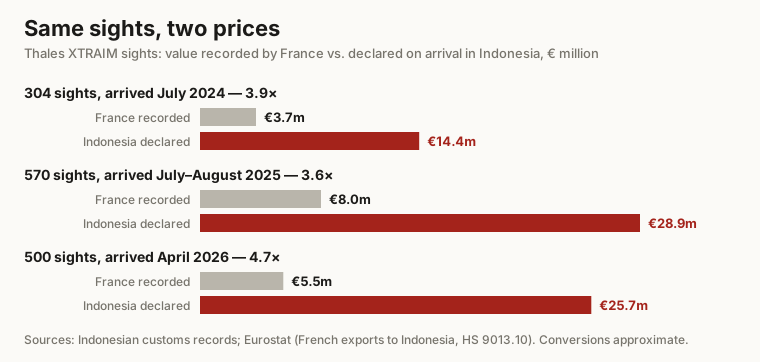
The fourth pair is left out of that total because it is not a clean match. France’s May and June 2026 figures include €3.9 million under a second code, binoculars, and probably cover goods for which the Indonesian lines had not yet appeared when the data were collected.
There are three obvious objections, and the records answer each of them.
The sights might sit under another French code. In Indonesia the same product was declared under four customs codes: telescopic sights, binoculars, spectacles and, in one June 2026 consignment, aircraft parts. But in March 2026 all French exports of optical and precision instruments to Indonesia, under every code, came to €8.0 million. France recorded no arms exports to Indonesia that month and no exports under confidential codes. The €25.7 million Indonesia declared would have been a third of everything France sold to Indonesia in March. Likewise, the June 2026 line declared in Indonesia as aircraft parts was worth €6.5 million; all French aircraft-related exports to Indonesia that month came to €0.65 million.
The French figure might cover different goods. It works out at 0.61 to 0.81 kilograms a sight across the three pairs. Thales gives the weight of the sight itself as 350 to 530 grams; a mount and case account for the rest. And France’s figure is the total for all French exporters to all Indonesian buyers under that code, so it is the most Thales could have recorded.
Freight and insurance. French values are recorded at the French border and Indonesian values include freight and insurance. The insurance declared on the Indonesian lines is under half a percent of value, and air freight on a tonne of cargo is small.
The French data imply a price of €11,000–14,000 a sight, which is consistent with the Thales representative’s estimate. The Indonesian declarations imply about €51,000.
What the police paid
Government payment records show a year-end payment of Rp 561,738,000,000 from the police mobile brigade, Korbrimob, to PT Indonesia Defence Systems in December 2025, carried over into 2026. The April 2026 delivery of 500 sights fits a year-end contract that slipped into the new year.
If those were the goods, the police paid about US$68,000 a sight. That is 15 percent above the declared import value and more than five times what France recorded.
I could not establish whether the payment figure includes value-added tax. If it includes the standard 11 percent, the importer’s visible margin over its own declared import value is only a few percent.
Whatever accounts for the fourfold difference, it sits before the goods reach Indonesian customs, not after.
The family
On 16 November 2009 the US Embassy in Jakarta reported to Washington on a “Blue Lantern” check, the State Department’s end-use verification for American defence exports. An embassy officer had visited a Jakarta company, PT Multijaya Sparindo, and met its registered arms broker, whose name the cable spells “Mulany Luwena”, and her husband, the chairman, “Jeffrey Luwena”.
The cable describes a company founded in 1988, with about thirty staff and US$20 million in annual sales, whose main clients were the Indonesian military and police. It says Luwena represented several US firms, including Raytheon and Northrop Grumman, and stored US Munitions List items with a firm in Florida. “We found the company to be legitimate,” the embassy wrote.
The couple are Milany Terianto and Jeffry Luwena, who both sit on Multijaya Sparindo’s board today. Seventeen years on, the business is far larger, and its centre is a company incorporated in 2014: PT Indonesia Defence Services, or IDS.
IDS maintains and modifies the police’s helicopters and aircraft: Bell 412s, Dauphins, NBO-105s, a Beechcraft 1900D and a CASA 212. It is the police’s second-largest non-fuel supplier. Government payment records show the police paid IDS Rp 4.31 trillion between 2022 and 2025, all of it through the water and air police, Korpolairud. With payments from the defence ministry and the armed forces, IDS received about Rp 8.25 trillion over the four years.
The police payments grew quickly: Rp 450 billion in 2022, Rp 434 billion in 2023, Rp 988 billion in 2024 and Rp 2.44 trillion in 2025. The 2024 figure can be checked against a second source. That year IDS won ten Korpolairud tenders on the government procurement portal, LPSE, worth Rp 988 billion, and the police paid it Rp 987.7 billion.
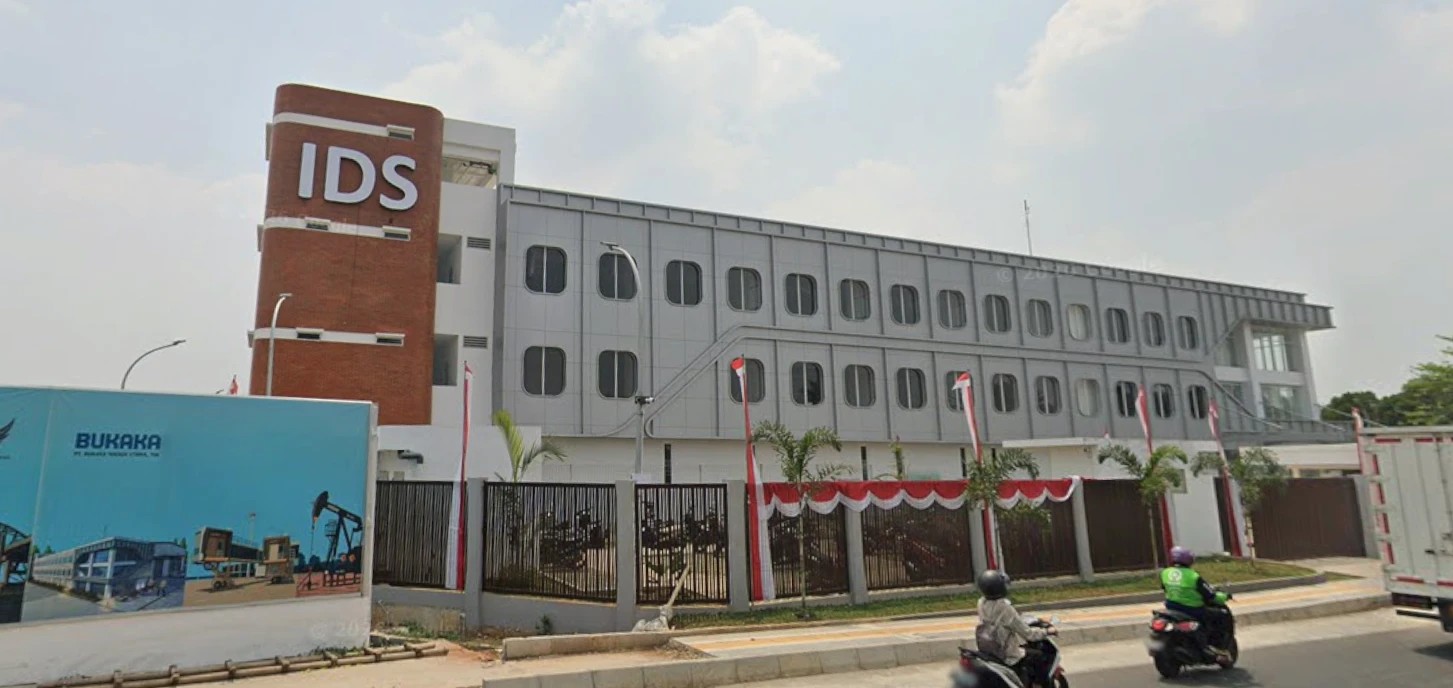
On 29 October 2026 IDS opened a new maintenance hangar in Pamulang, on the southern edge of Jakarta, roughly half a kilometre outside the perimeter of Pondok Cabe airfield, the home of the police air wing. The building has three storeys and, according to an environmental filing, about 7,244 square metres of floor space. The commander of the navy’s aviation centre attended. According to the navy’s account, a director-general from the defence ministry and the head of the police air directorate gave speeches. The contractor was Bukaka, an engineering company in the Kalla Group.
Company filings show that IDS is held through three vehicles, each owned by one person. On a look-through basis, Milany Terianto controls about 60 percent of IDS, and Hillary Luwena and Karel Luwena about 20 percent each.
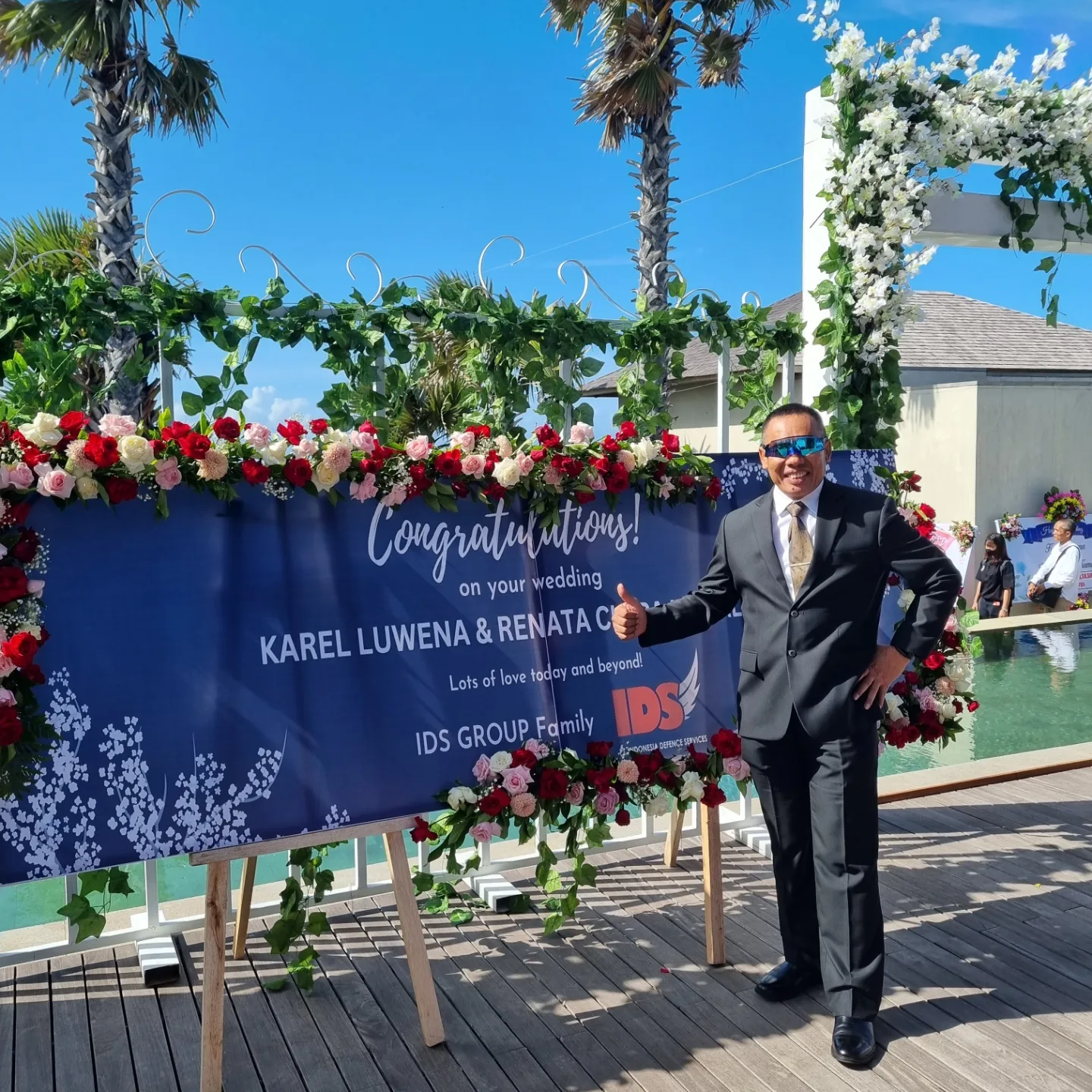
Karel Luwena is the son of Milany Terianto and Jeffry Luwena: a public Instagram post of January 2023, written by a guest at his wedding, congratulates “Bapak Jepry Luwena dan Ibu Milany Terianto” as the groom’s parents. A 2020 company deed records Hillary Luwena, born a year before Karel, at the same home address as Milany Terianto and Karel. Lenny Terianto, who sits with Milany on several of the family’s boards, has been IDS’s president director since at least 2017. How the two are related is not documented.
IDS is one of at least twenty companies registered to a small cluster of addresses: on Jalan K.H. Wahid Hasyim in Kampung Bali, Tanah Abang, and on the 10th, 11th and 17th floors of Menara Ravindo on Jalan Kebon Sirih. Four of them matter here.
- PT Multijaya Sparindo, the company in the 2009 cable, now a supplier of police interception equipment. IDS owns a stake in it.
- PT Indonesia Defence Maritime. Its website says it is “part of the IDS Group”. It was founded in October 2020, under the name PT Indonesia Defence Manufacturing, with IDS holding 88 percent and a Singapore company represented by Milany Terianto holding the rest. Karel and Hillary Luwena were its first commissioners.
- PT Kencana Wiratama Sejati, which holds the title to the family’s Wahid Hasyim buildings and in which IDS also owns a stake. One of those buildings, No. 168, was pledged to a bank in 2018 as “Hotel Kiara”.
- PT Indonesia Defence Systems, the importer of the Thales sights. No Luwena appears among its registered shareholders or officers. The ties are these: it is registered at Wahid Hasyim No. 168, the building owned by the family company; and its president director, Azmi Fuadi, was IDS’s quality director in 2019 and the first director of Indonesia Defence Maritime in 2020.
The generals
Two retired flag officers sit on the boards of the family’s companies.
Irjen Pol (Purn) Zulkarnain Adinegara commanded Korpolairud, the unit that has since paid IDS more than four trillion rupiah, from 20 June to 21 October 2019, after serving as police chief of South Sumatra. He is now president director of Multijaya Sparindo and of Kencana Wiratama Sejati, and a director of two further family companies.
The registry shows him on the group’s boards from June 2022. His own Instagram posts suggest the tie is older. He describes attending IDS’s year-end events in 2021 and 2022, and in April 2024 wrote that he was at his fifth IDS iftar, which would put his start soon after he left the command. He was also the wedding guest who wrote the January 2023 post quoted above. The photograph at the top of this article is from that post.
IDS’s two Korpolairud tenders in 2019 were awarded in March, before his appointment. None appears during his four months in command.
Marsdya TNI (Purn) Wieko Syofyan was deputy chief of staff of the Indonesian Air Force from 2018 and later deputy governor of Lemhannas, the national resilience institute, a post he appears to have left in 2022. He is now a director of IDS and president director of PT Citra Wira Bawana, a family company that imports medical rehabilitation robots and appears in navy tender records for rehabilitation equipment.
Neither appointment is unlawful. But together they place a former commander of the police unit that pays IDS, and a former deputy air force chief, inside a family business whose revenue comes almost entirely from the security services.
The same multiple, elsewhere
The XTRAIM is not an isolated case. Where other imports by these companies can be matched to an exporting country’s records by date, product code and weight, the pattern repeats:
- A helicopter main gearbox from Ex Change Parts AB, Sweden (June 2026). Indonesia declared US$4.57 million at 300 kg. In May 2026 Sweden recorded aircraft-part exports to Indonesia of €0.90 million at 322 kg. That is about 4.4×.
- A Bell 412 air-ambulance kit from Air Ambulance Technology, Austria (July 2021). Indonesia declared €1.06 million at 448 kg. Austria recorded €78,000 at 422 kg under the same product code that month. That is about 13×.
- Helicopter medical interiors from Spaes GmbH, Germany (October 2024). Indonesia declared about €3.25 million. Germany’s total aircraft-part exports to Indonesia over three months came to €0.53 million, which puts the declaration at 6× Germany’s figure or more.
The method can also confirm a declaration. A 2021 satellite-communications shipment from Airborne Technologies of Austria matched Austria’s export figure to within 10 percent. That is what an honestly valued consignment looks like in these data.
Nor is the gap confined to this family. In October 2024 a Hungarian-registered company with no known connection to the Luwenas, United Collaborative Group Kft, shipped a P25 police radio system from Christchurch to the police finance bureau. Indonesia declared it at US$182.9 million. New Zealand’s statistics agency recorded about US$16 million of matching exports to Indonesia that month.
Part of that gap has an ordinary explanation: US$56 million of the Indonesian declaration is software and licences, which export statistics for goods do not capture. On hardware alone, the multiple is roughly 8×. On the one category where units can be compared directly, some 10,000 radios, it is 4.0×.
The Luwena companies are the case examined here because their imports come from European manufacturers whose home countries publish monthly export data detailed enough to match shipment by shipment. A gap that recurs across different suppliers, countries and years is hard to explain as a pricing quirk. It points to how the paperwork is produced on the Indonesian side.
By way of Sofia and Budapest
Indonesia has no diplomatic relations with Israel. Some of the equipment these companies import appears to come from there anyway.
On 7 April 2026 PT Indonesia Defence Maritime took delivery at Soekarno-Hatta of 2,646 5.56 mm assault rifles, in 11.5-inch and 14.5-inch versions, each with four magazines, a sling and a rail, and 2,646 red-dot sights. The declared value was US$24.7 million. The brand field reads “ARDA (MEPRO)”. The seller was World Trade Logistics Ltd of Sofia, Bulgaria.
The importer describes itself as a shipbuilder. Its only published address is an office on the 17th floor of Menara Ravindo, and it has no tender wins on LPSE.
Bulgaria’s statistics record no arms exports to Indonesia at all between January and August 2026. Its exports of weapon sights to Indonesia that April came to €10,892.
The same Sofia company appears on other Indonesian customs lines. In June 2026 it shipped “NEGEV 7.62 LMG KIT” and “MEPRO MVO TELESCOPE … FOR ARAD 7.62 DMR” to a different Jakarta importer, with Tel Aviv given as the port of loading. The Negev is a machine gun made by Israel Weapon Industries (IWI), the ARAD is IWI’s assault rifle, and Meprolight (MEPRO) is IWI’s sister optics company. The descriptions point to IWI ARAD rifles with Meprolight sights, sold through a Bulgarian trading company. I have not seen the rifles or their end-user paperwork.
Government payment records show a year-end Korbrimob payment of Rp 463,273,587,000 to Indonesia Defence Maritime, carried over into 2026 in the same way as the Thales payment. It is about 1.14 times the declared import value, the same ratio as the sights.
The second route runs through Budapest. Clarity Systems Ltd of Tel Aviv owns two Hungarian companies, Euro Tech Solutions Kft and URmine Plus Kft. Between August 2024 and February 2026 they sold “Active Monitoring Systems”, the customs description for cellular interception equipment, to three of the family’s companies:
| Buyer | Hungarian seller | Date | Declared value | Notes |
|---|---|---|---|---|
| Multijaya Sparindo | URmine Plus | Aug 2024 | US$10.4M | Bareskrim, the criminal investigation agency, paid Multijaya Rp 121 billion the same month |
| Indonesia Defence Systems | Euro Tech | Jul–Oct 2025 | US$44.1M | five lines of exactly US$8,819,080 |
| Kencana Wiratama Sejati | Euro Tech | Feb 2026 | US$13.75M | “Active Monitoring System — VERTEX” |
Every consignment was flown from Budapest. Hungary recorded none of them as exports. In October 2025 the Euro Tech declarations alone were four times Hungary’s total exports to Indonesia that month.
An absence from Bulgarian or Hungarian export statistics is not in itself improper. Goods that pass through a country in customs transit, or are only invoiced from there, are not counted as its exports. What the absence does mean is that no exporting country’s record exists against which the declared values can be tested.
For the rifles and the interception systems, the Indonesian declaration is the only number there is.
Multijaya Sparindo has been a buyer of this kind of equipment for years. Since 2017 it has won twelve police tenders for “Active Interception and Monitoring” and “communications network detection” equipment, worth about Rp 1.39 trillion. Four of them, in 2020, carried an identical owner’s estimate of Rp 116,065,447,700. Its other suppliers include Tiersec, a Cyprus-registered company shipping from Dubai (a cellular interception system and a phone-extraction kit, 2021), and SIGN4L, an Abu Dhabi firm (US$9.7 million, 2023, declared on two identical lines).
The Singapore half
Most of what IDS imports does not come from Europe. It comes from Singapore, from a company the family owns.
Also Private Limited, at 7 Temasek Boulevard, Suntec Tower One, has been IDS’s main supplier: about 1,690 of roughly 2,000 IDS import lines, and US$152.8 million in Indonesian customs records since 2018, US$135 million of it sold to IDS. Its filings with ACRA, Singapore’s company registry, list as directors Milany Terianto, Lenny Terianto, Jeffry Luwena, Hillary Luwena and a Singaporean, Lee Say Seng. ACRA records Milany Terianto as deemed to own the whole company through two Singapore holding firms. In 2018 Also Private itself held about a third of IDS’s shares.
Also’s audited accounts for 2025 record no revenue; for 2024, US$13,190.
Its auditor qualified the 2025 accounts. Among the reasons given: the company “transacts with the armed forces of a neighbouring country”, and some documents were unavailable “due to the classified nature” of those transactions. A second family company, Multijaya Sparindo Singapore Pte Ltd, shares the same office and supplies IDS with radios and aircraft spares.
One consignment shows the prices involved. On 28 April 2026 IDS imported from Also four sets of ship autopilot and gyrocompass equipment declared at US$5.29 million, with a combined declared weight of 58.4 kilograms:
| Item | Declared | Each |
|---|---|---|
| 4 autopilot operator units | US$1.93M | ≈ US$482,000 |
| 4 alarm status interface units | US$1.55M | ≈ US$388,000 |
| 4 gyrocompass systems | US$0.90M | ≈ US$224,000 |
| Distribution units | US$0.69M | |
| Installation kits | US$0.22M |
The same items, Raytheon Anschütz-type Pilotstar NX autopilots and Standard 30 MF gyrocompasses, appear on 2022 lines at similar prices. They supply Korpolairud’s annual “ship autopilot capability upgrade” tenders, each worth Rp 44–151 billion.
Because Also is family-owned, no Indonesian record shows the price at which it bought what it sold to IDS, or the margin it took.
What the numbers prove, and what they don’t
The comparisons in this article set two official records against each other: Indonesian customs declarations and the exporting countries’ statistics. They do not show where any money went.
Comparing two countries’ trade records is an established method with known weaknesses. Shipments can fall in different months, be classified under different codes, pass through a third country, or be hidden by confidentiality rules. Each is dealt with above: by matching on weight as well as date and code, by checking every neighbouring code and month, and by treating the exporting country’s figure, which covers all exporters, as an upper limit. Where a route cannot be tested, as with Bulgaria and Hungary, the article says so and draws no multiple from it.
Three explanations fit the gap where it can be measured:
- The Indonesian declaration overstates what was paid abroad. The importer or its broker sets the declared value. Proof of payment is not required at clearance. Customs scrutiny targets under-declaration, because that costs the state duty; defence goods are usually duty-exempt, so over-declaring costs nothing at the border. A high customs value then supports a high contract price when state auditors check it.
- The importer paid an invoice to someone other than the manufacturer’s exporting entity, so the manufacturer’s export value is low and the difference stays with the invoicing party.
- Some of the difference is real: bundled services, small-order export premiums, financing costs.
The third explanation can account for a margin, but not for a fourfold difference in the value of goods recorded crossing a border.
What the records do show is consistent:
- a declared import value about four times the exporter’s figure;
- a state payment about 1.15 times the declared import value;
- a supply chain in which the first foreign link is often a company owned by the importer’s own family.
The missing invoices
Two governments have put a value on the same crates, and the figures differ by a factor of four. The Indonesian state then paid a little more than the higher one.
The records cannot say which figure is right, or who kept the difference if the lower one is. A single set of documents can: the commercial invoices filed with Indonesian customs, and the bank transfers that paid them. Customs holds the first. The importers hold both.
PT Indonesia Defence Services did not respond to written questions sent in early November 2026.
Until someone produces those papers, the question the numbers raise stays open: what did Indonesia’s police actually buy for twelve trillion rupiah, and what was it worth?
Sources and method. This article draws on Indonesian government payment and tender records, Indonesian customs import data, the official export statistics of the supplying countries (Eurostat, Stats NZ and UN Comtrade), company filings in Indonesia and Singapore, a 2009 US diplomatic cable, press reports and public social-media posts. Export statistics are national totals for all exporters, so they overstate what any one supplier shipped. Currency conversions are approximate. The comparisons are findings about records, not findings of wrongdoing.