Investigation
The Borrowed Flag
South Korea's missile maker LIG Nex1 sold Indonesia's police $590 million of radios, networks and helicopter parts it does not make. The equipment came from American and European manufacturers, most of it was imported by companies of a Jakarta family, and it was paid for with foreign loans that never pass through the police's public accounts.
On 26 March 2024 a consignment for Indonesia’s national police cleared customs at Soekarno-Hatta airport. It had been flown from Los Angeles, and its sixteen customs lines describe the backbone of a police computer network: 18,082 Wi-Fi 6 access points, 482 “next-generation firewalls with machine learning”, 3,220 network switches, wireless controllers and a security-management system for a data centre, each item earmarked for a regional police command or a district station. The importer was PT Titan Jaya Solusi, a Jakarta company. The seller was LIG Nex1, one of South Korea’s major defence manufacturers. The declared country of origin was Korea. The declared value was $103.2 million.
That month, the United States recorded exporting 19,220 Wi-Fi access points to Indonesia, close to the same number. US export statistics value them at $3.3 million, about $173 each. The Indonesian declaration values the 18,082 access points at $35.9 million: 10.8 times as much in total, and 11.5 times as much per unit. An indoor unit was declared at $1,729. A mainstream enterprise Wi-Fi 6 access point lists at about $390 in the United States.
The Wi-Fi shipment is one of 289 customs lines in which LIG Nex1 is the seller and Indonesia’s police, or companies working for them, are the buyers. Together they are worth $456.6 million. LIG Nex1 makes missiles, torpedoes and radars. None of what it sold the police was its own product. Its own radios appear only once in the data, in a $1.4 million shipment from Busan in 2018 to the state arms maker Pindad. Everything that went to the police was made by other manufacturers in the United States and Europe and shipped from their plants and depots.
This investigation combined five sets of records: the Indonesian customs lines, the export statistics of the countries the goods left from, LIG Nex1’s filings to Korea’s financial regulator, the Singapore accounts of the company LIG paid to deliver the goods, and Indonesian loan and audit records. Together they show three parties. LIG Nex1 holds the contracts. A Singapore company tied to the Silfanus family received LIG’s advance payments. Foreign loans pay the bill, through a route that keeps the money out of the police’s published payments.
A missile maker in the radio business
LIG Nex1, renamed LIG Defense & Aerospace in March 2026, is listed on the Korea Exchange. It builds the Cheongung air-defence missile, which it has sold to the UAE, Saudi Arabia and Iraq, as well as heavyweight torpedoes, the radar for the FA-50 fighter and the electronic-warfare suite of the KF-21. Its 2025 revenue was ₩4.31 trillion. It has supplied Indonesia’s army with its own PRC-999K field radios since 2006, and in 2011 it won a $7 million contract for a trunked radio system in Indonesia’s border areas.
From 2020 the scale changed. LIG’s filings to Korea’s disclosure system, DART, list four contracts with “the Indonesian Police”:
| Contract (as filed) | Signed | Value as filed | Took effect |
|---|---|---|---|
| Police communication system (“hand-held radios and network infrastructure”) | 20 May 2020 | $130.00M | Q4 2021 |
| Police secure communication network | 22 Dec 2022 | $159.91M | late Dec 2023 |
| Police multiband communication network | 22 Dec 2022 | $149.94M | late Dec 2023 |
| Police helicopter spare parts | 13 Apr 2023 | $149.85M | Jul 2025 |
| Total | $589.71M |
Each contract was signed and then sat dormant for one to two years. LIG’s amended filings give the same reason every time: the contract would take effect only “upon the opening of the L/C”, the letter of credit through which it would be paid.
LIG’s annual reports name the customer. Under “major customers” they list the Indonesian National Police, “export, communication equipment”: ₩121.7 billion in 2022, ₩42.9 billion in 2023 and ₩322.6 billion in 2024, which was 9.9 percent of LIG’s sales. That made the Indonesian police its third-largest customer, behind only Korea’s own defence procurement and defence research agencies. LIG’s commentary to investors tracks each delay. In 2021 the police radio contract’s “effectiveness was delayed by more than a year”. In 2023 revenue from the police communication network was “deferred”. In 2024 it “was recognised”.
What actually arrived
Indonesian customs records name the seller, the importer, the goods and the port where they were loaded. The LIG lines fall into a few consignments:
| Cleared | Importer | Loaded at | Declared | What |
|---|---|---|---|---|
| Jul–Aug 2022 | Police finance centre (Puskeu) | Penang; Oradell, New Jersey | $79.4M | Digital radios and repeaters; 16,385 “soft-switch push-to-talk software licences with Astro interoperation”; radio gateways |
| Oct 2022 – May 2023 | PT Sumberniaga Kharismanusa | Penang | $41.8M | 11,881 “handheld device soft switch” units; batteries for “Motorola APX1000i” radios and “LTE Motorola” handhelds |
| Mar–Sep 2024 | PT Trutama Star | New York, Sydney, Miami | $118.7M | 14,760 “portable radio P25 & LTE”; P25 core and broadband platforms; repeaters; dispatch consoles |
| Mar 2024 | PT Titan Jaya Solusi | Los Angeles | $103.2M | Firewalls, Wi-Fi 6, switches, wireless controllers |
| Jan & Jun 2026 | Police air and water unit (Korpolairud) | Kuala Lumpur | $113.6M | Helicopter gearboxes, rotor blades, flight computers, inspection kits, an autopilot upgrade |
| $456.6M |
Matched to the contracts by timing and product, the shipments cover 93 percent of the radio contract, 72 percent of the two network contracts and 76 percent of the helicopter contract. The matching is ours; the customs lines do not cite contract numbers.
The radios carry other makers’ names. The 2023 Penang shipments include batteries for Motorola radios and handhelds, and Motorola Solutions has a large plant in Penang. “Astro” is Motorola’s digital trunking system, which Indonesia’s police already use. The 2024 P25 and LTE handsets were declared at about $5,980 each and flown out of New York and Miami. That matches Motorola’s US-built APX NEXT class and is close to list prices for that class. The Los Angeles network equipment reads like one American security vendor’s product range, though no brand appears on the lines.
The helicopter parts were coded as radar equipment, including the main gearboxes and rotor blades, and 148 of the 217 lines carry an identical weight of 21.95 kilograms. These are placeholder entries, not weighed goods, which makes the declarations impossible to check against the physical shipments. The parts list, which includes an aircraft and mission management computer, an avionics switch, an emergency flotation system and an “Upgrade Phase 6”, matches the Leonardo AW169 and AW189 helicopters that Indonesia’s police fly. The parts were loaded in Kuala Lumpur, where Leonardo runs its Asia-Pacific maintenance and logistics hub. LIG Nex1 does not make helicopter parts.
On most of the 2024 lines the declared country of origin is “KR”, although the goods were loaded in the United States and Australia. A Korean origin could matter if it qualified the goods for a trade preference or for Korean export-credit cover. We found no Korean export-credit facility for these contracts, and because the police’s imports carry no duty, no customs benefit is apparent. The likeliest explanation is that the field simply repeats the seller’s country. It is still wrong.
Priced far above export value, at least in one case
Every country publishes what it exports, by product code and month. We compared each LIG consignment with the export statistics of the country it was loaded in, using the same four-digit product codes the goods were declared under in Indonesia and the total for every exporter in that country:
| Consignment | Declared in Indonesia | Loading country’s exports to Indonesia, same codes and month | Share |
|---|---|---|---|
| Mar 2024, Los Angeles and New York | $187.3M | United States: $24.4M | 13% |
| of which Wi-Fi access points | 18,082 units, $35.9M | 19,220 units, $3.3M | 9% |
| Sep 2024, Miami | $29.0M | United States: $8.3M | 29% |
| Aug 2022, Oradell | $59.9M, of which $40.0M software licences | United States: $12.5M | 21% |
| Jul 2024, Sydney | $5.5M | Australia: $0.29M | 5% |
| Jan 2026, Kuala Lumpur | $80.8M | Malaysia: about $1.5M | about 2% |
| Jul 2022 – May 2023, Penang | $61.3M | Malaysia: 9–45%, month by month | — |
Much of these gaps can have innocent explanations. Goods that pass through an airport in transit are not counted as exports; the Kuala Lumpur parts may have come from Italy via Leonardo’s depot. Software licences are not counted as goods. The Penang comparison is the weakest, because Malaysia is a large electronics exporter and small differences in how a radio is classified could move it between codes.
The Wi-Fi line is the clearest case. The United States recorded the shipment: the unit count matches within six percent. The US export value, $173 a unit, is below the American list price of about $390, which suggests a manufacturer’s price to its distributor. The Indonesian price, $1,729 per indoor unit, is about four times the list price and ten times the export price. Part of the difference may be installation, licences, warranties and the cost of financing. The customs lines do not break these out.
The radios point the other way. At about $5,980 each, the 2024 handsets were declared close to list price. The evidence does not support a uniform markup across everything LIG sold. It shows one product line priced far above its export and list values, and many shipments that the exporting countries’ statistics do not show.
A second comparison places the pricing. LIG’s annual reports put its revenue from the Indonesian police at ₩487 billion over 2022–24. The non-helicopter customs lines total about $343 million, roughly ₩446 billion. The Indonesian customs values track LIG’s own billing to the police. Wherever the Wi-Fi price was set, it was not inflated at the Indonesian border. It is the price the police contract carried.
The company behind the contractor
LIG Nex1 must disclose large payments to its investors. Two of its filings name the company behind it.
On 21 December 2021, two weeks after its first police contract took effect, LIG disclosed an advance payment of ₩28.7 billion (about $24 million) “under the delivery contract for the radio project”. The payee was Grandrich Corporation Pte Ltd of Singapore “and two other companies”; LIG named only the largest payee, “for defence-security reasons”. On 29 December 2022, a week after signing the two network contracts, it disclosed a second advance to Grandrich alone: ₩44.5 billion ($35.1 million) “under the delivery contract for the Indonesia communication-network project”. The contract would not take effect for another year.
LIG attached Grandrich’s financial figures to both filings. They match Grandrich’s audited Singapore accounts, converted into won, so LIG had seen its subcontractor’s books. No filing names Grandrich in connection with the helicopter-parts contract, and we found nothing to show who supplies LIG on that one.
Grandrich is not new to the Indonesian police. It appears in customs records as “Motorola Authorized Distributor Grandrich”, with about $150 million of sales to the police under that name and $203 million more as plain Grandrich. In 2019 it sold the police two AW189 and five AW169 helicopters, the fleet for which LIG later contracted to supply spare parts.
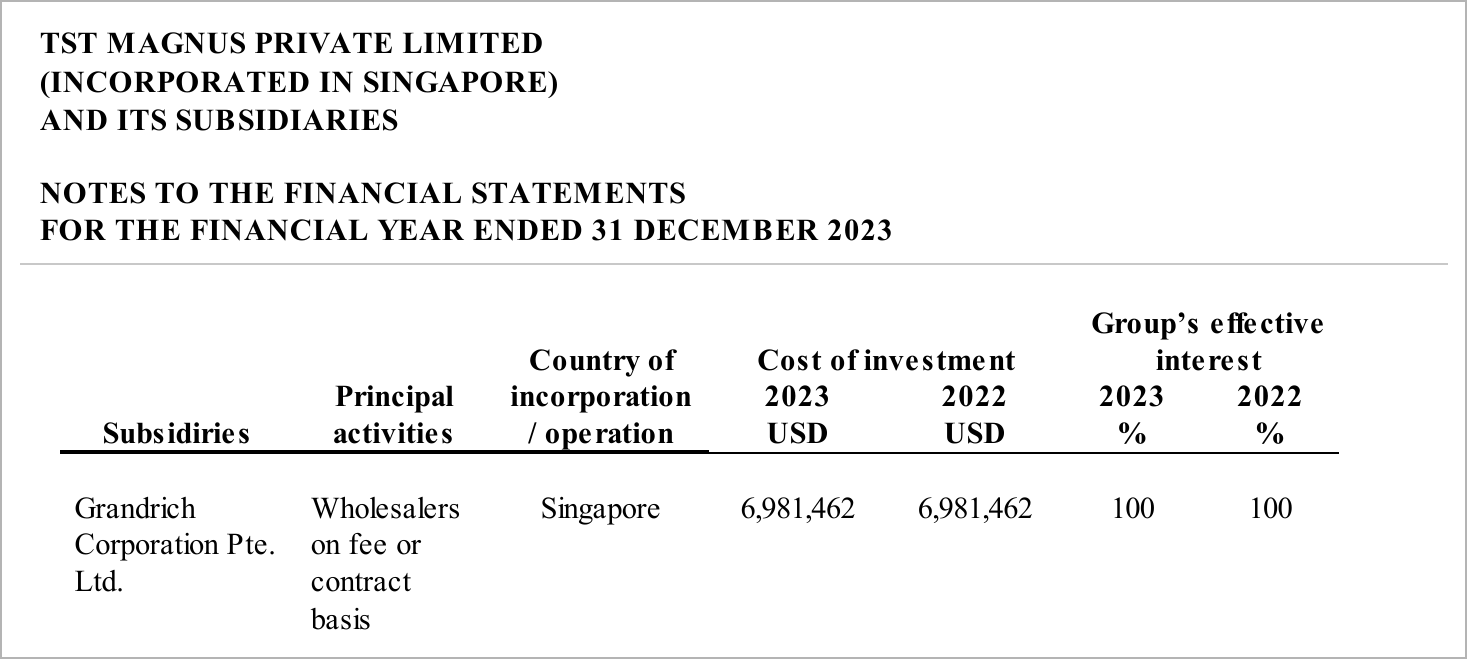
Grandrich is owned by a Singapore holding company, TST Magnus, which belongs to Prime Elite Developments, a company in the British Virgin Islands whose owners are not on public record. The records tie Grandrich closely to the Silfanus family of Jakarta, whose holding company, PT TJ Silfanus, is one of the police’s largest private suppliers (see The Shadow Supplier):
- Until at least 2017 Grandrich was owned half each by two Singaporeans, Tan Lu Dong and Ng Soo Tiong. Tan Lu Dong, identified by the same national identity number, is a director of TJ Infotech Pte Ltd, in which Tommy Jacobus Silfanus owns 49 percent.
- In 2018 the Business Times reported that the option to buy level 20 of Samsung Hub, the floor where Grandrich has its offices, had been granted to a company whose ultimate shareholders were Ryan Kristoffer Silfanus, Tan Lu Dong and Ng Soo Tiong.
- Jonathan Silfanus describes himself on LinkedIn as Grandrich’s deputy chief investment officer.
On the Indonesian side, 58 percent of LIG’s police deliveries, $263.6 million, were imported by three subsidiaries of PT TJ Silfanus. The police imported the rest themselves, including the 2022 radios and all the helicopter parts.
| Importer | Imported from LIG | PT TJ Silfanus stake | Public payments from police and BIN, 2022–25 |
|---|---|---|---|
| PT Trutama Star | $118.7M | 85–97% | Rp223 bn, police IT division, 2022 |
| PT Titan Jaya Solusi | $103.2M | about 98% | Rp300 bn: BIN, police IT division, traffic police |
| PT Sumberniaga Kharismanusa | $41.8M | 85–97% | Rp992 bn, Mobile Brigade |
The three companies were also paid directly through the government’s rupiah payment system. Those payments carry no project descriptions. Whether they cover the local portion of LIG’s projects, such as installation, or entirely separate work cannot be told from the records.
Inside Grandrich’s books
Grandrich files accounts in Singapore, and so does its parent. The available accounts cover 2020 to 2023.
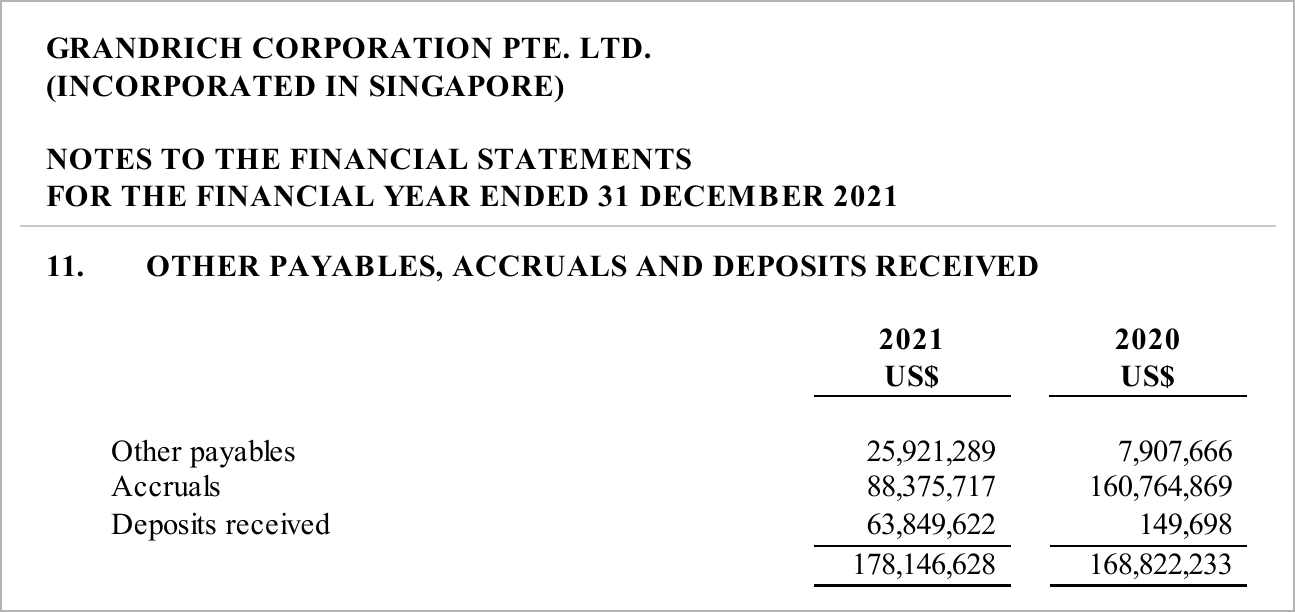
Deposits rise sharply. In Grandrich’s 2021 accounts, “deposits received” jump from $149,698 to $63.8 million. LIG paid its first advance, about $24 million, at the end of that year.
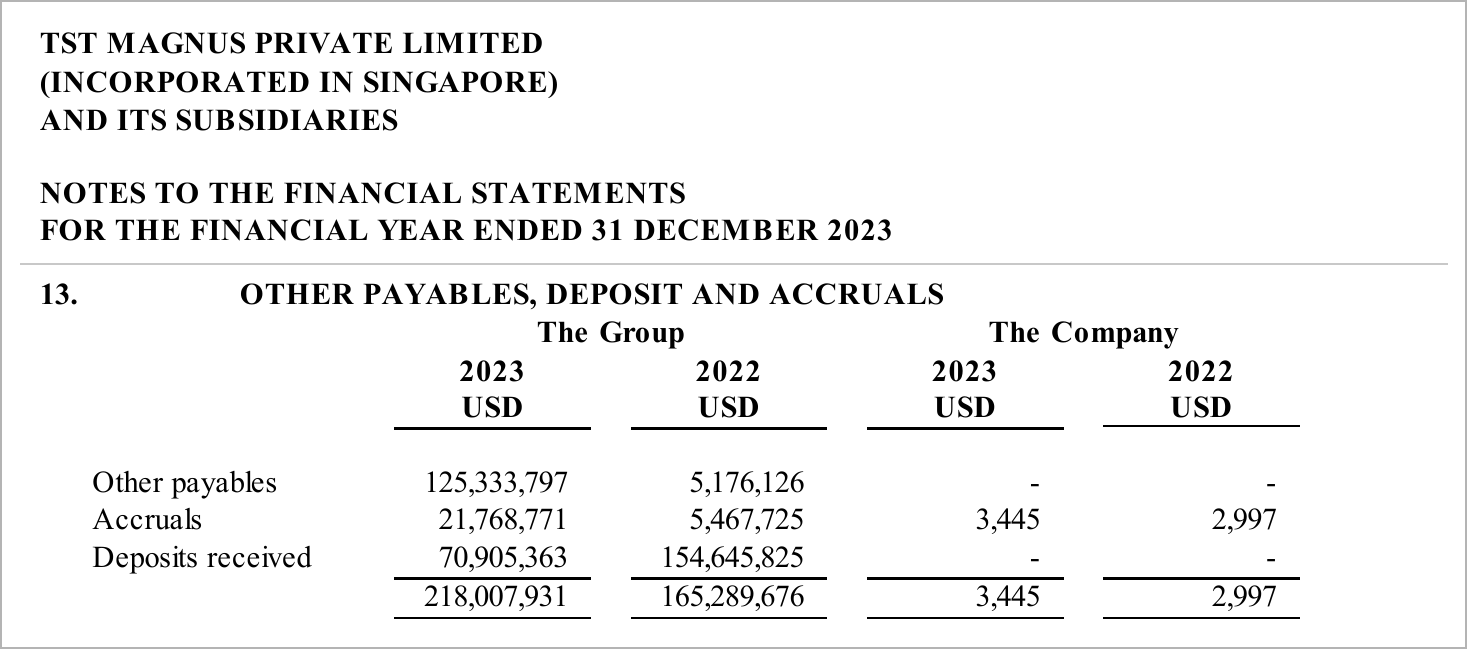
At the end of 2022, a week after LIG’s second advance, the group’s deposits received stood at $154.6 million. LIG’s two disclosed advances total about $59 million, so they can account for only part of these deposits. The accounts do not say who paid the rest.
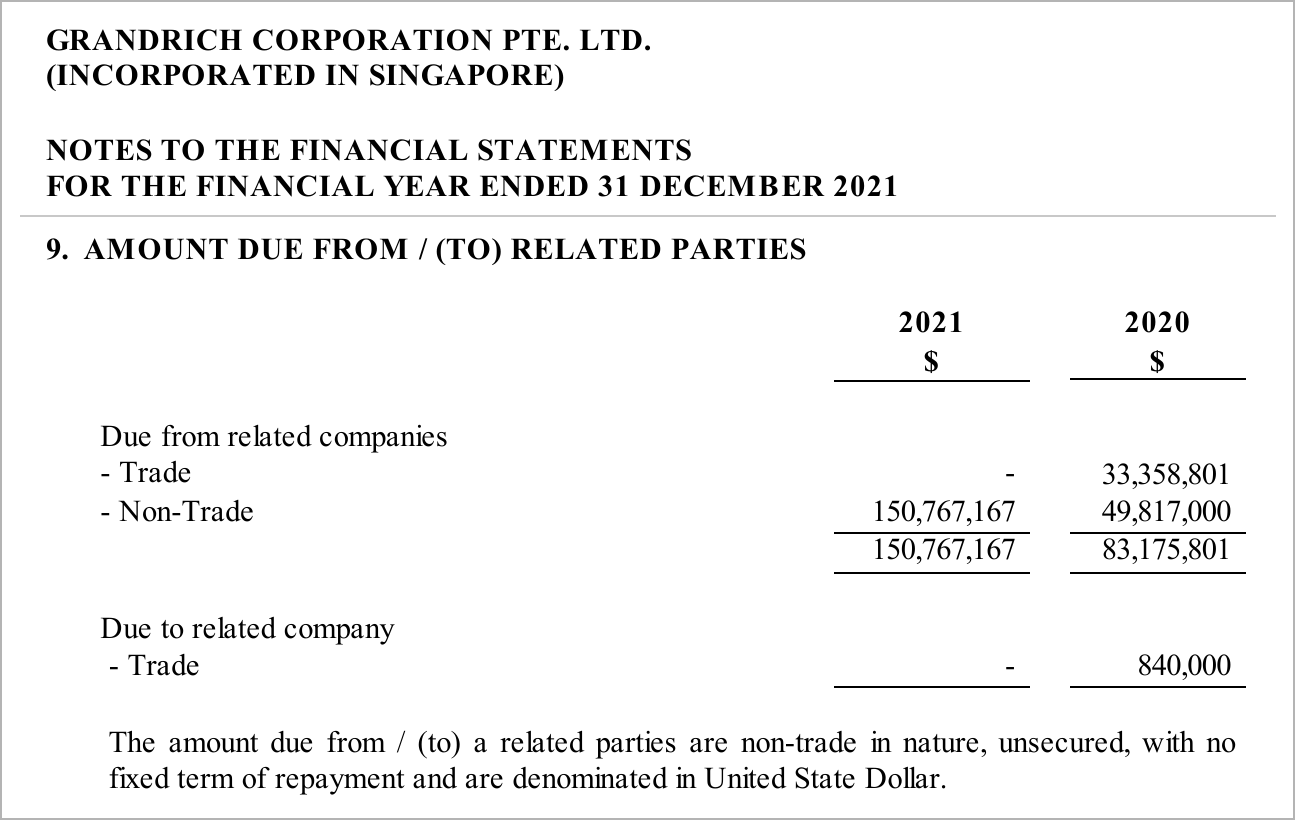
Money moves to the parent. By the end of 2021 an unnamed “related party” owed Grandrich $150.8 million: non-trade, unsecured, with no fixed date for repayment. The balance had already been $83.2 million at the end of 2020, before any LIG payment. Grandrich’s cash fell from $45.2 million to $0.67 million during 2021.
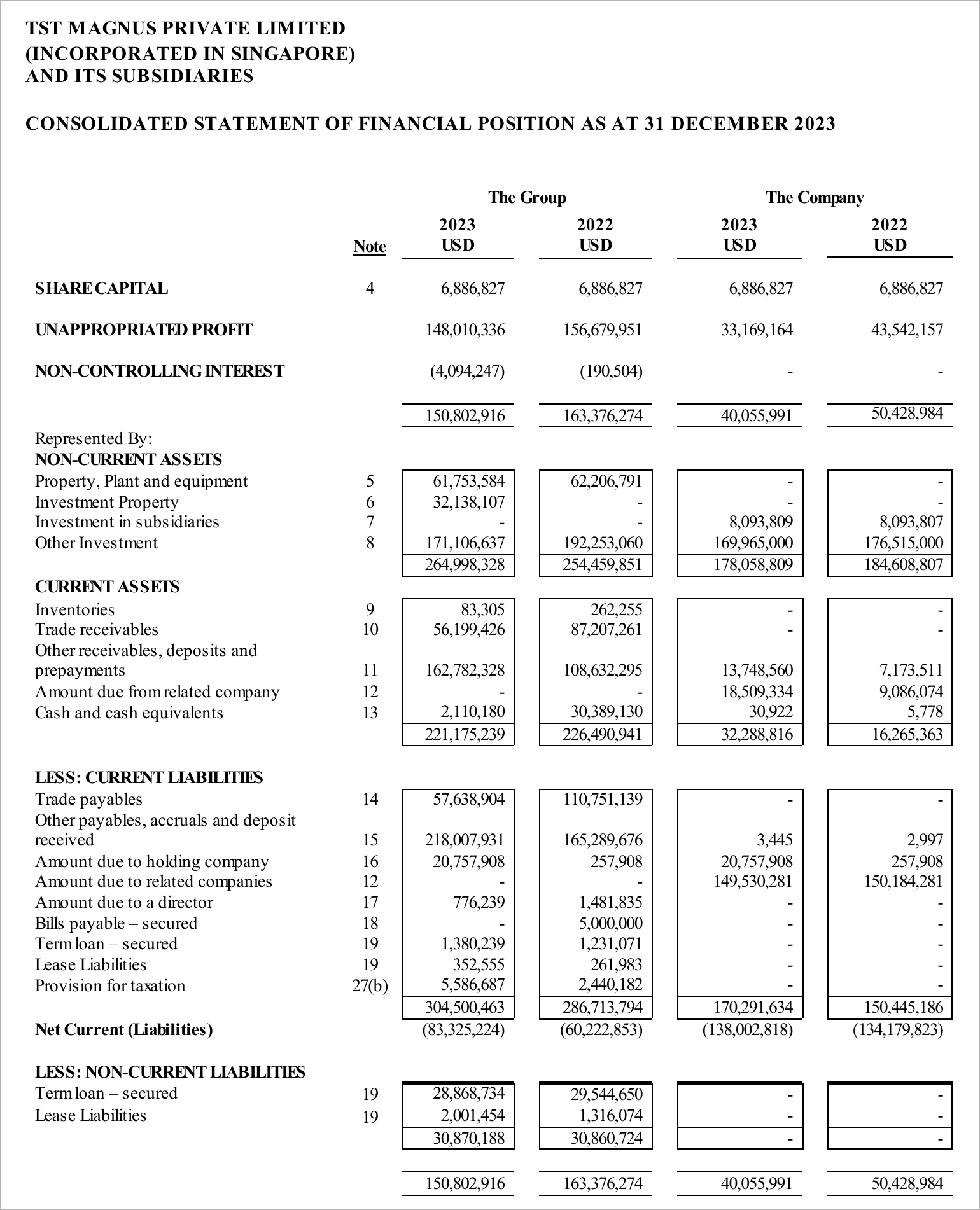
The parent’s balance sheet identifies the borrower. In 2022 and 2023 TST Magnus owed $150.2 million and $149.5 million to a related company. In the consolidated group column the same line is blank, which means the lender sits inside the group. Grandrich is the only subsidiary of that size.
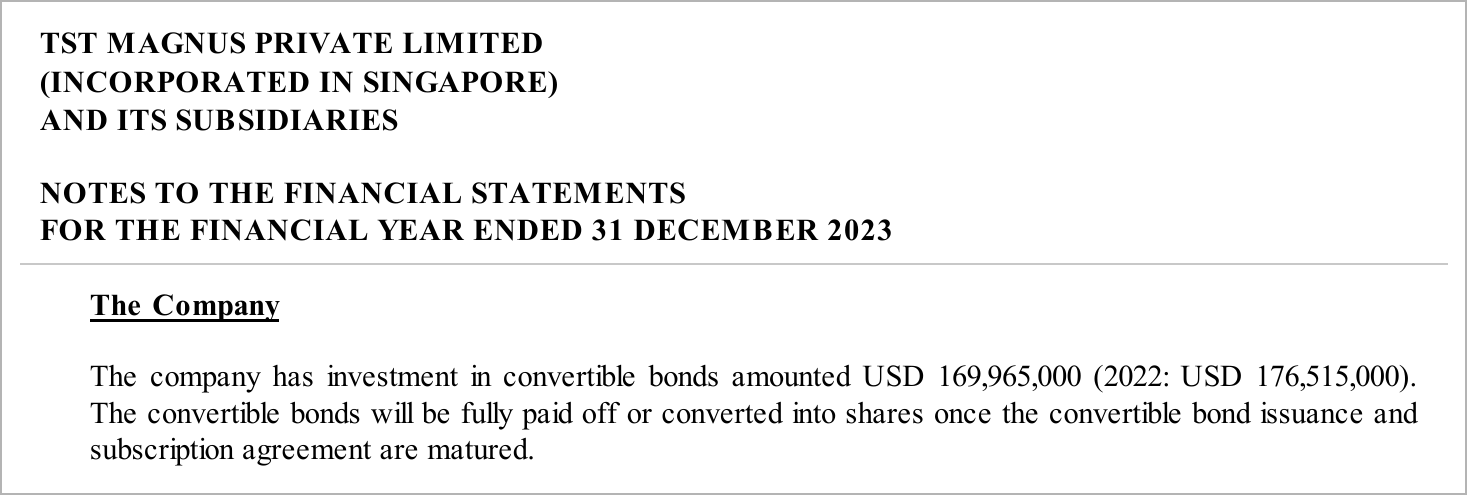
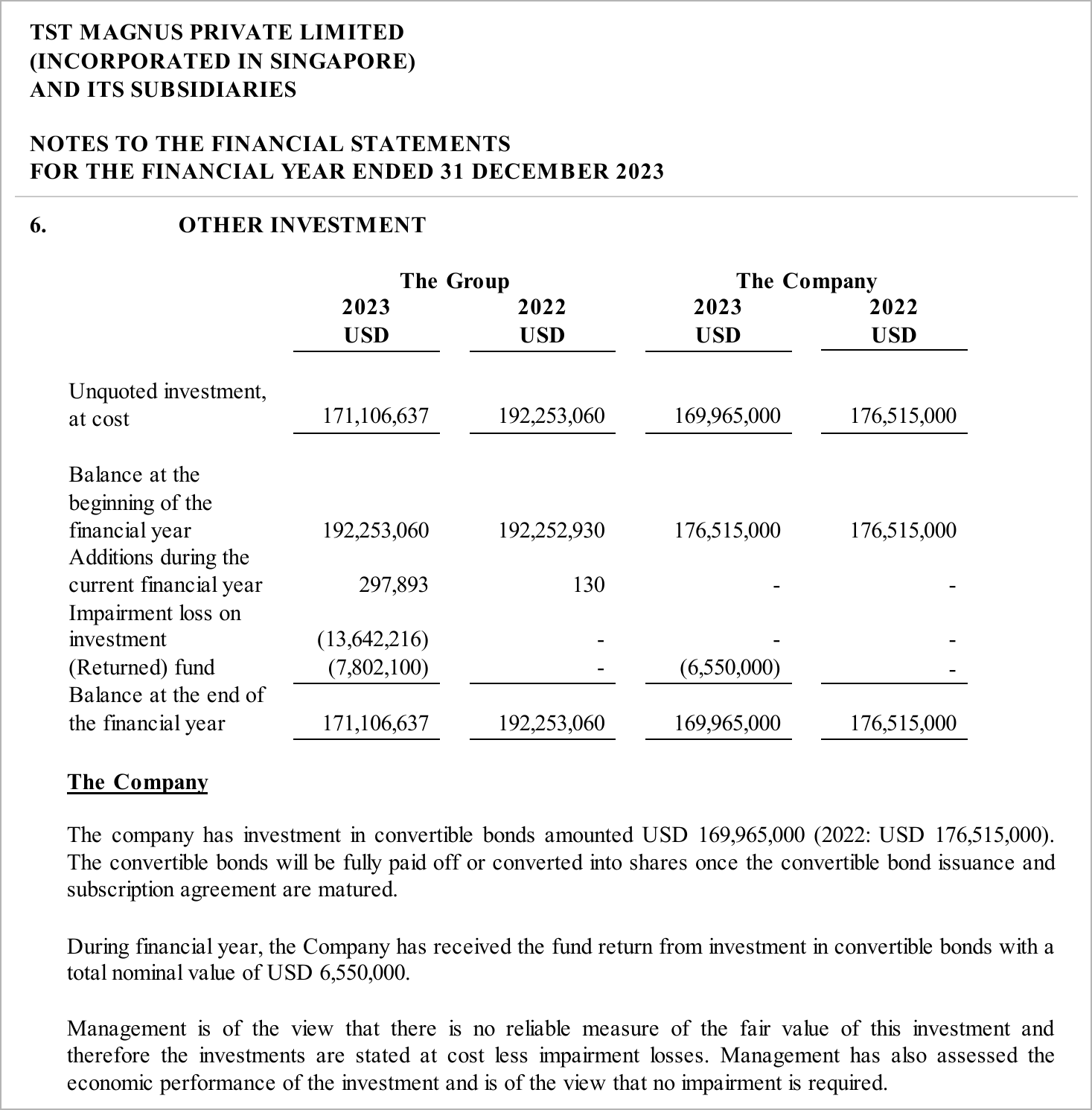
The parent’s main asset is a bond from an unnamed issuer. TST Magnus holds an “investment in convertible bonds” of $176.5 million at the end of 2022 and $170.0 million at the end of 2023. The accounts do not name the issuer. Management says the bonds’ value “cannot be reliably measured” and carries them at cost.
In 2023 TST Magnus paid a $21 million dividend to its BVI owner, which lent almost all of it straight back. Its auditors qualified their opinion in both 2022 and 2023, citing a lack of access to the working papers of “overseas subsidiaries”; the group had two Delaware companies, both struck off in 2023, which may be what they meant.
Most of Grandrich’s business does not appear under its own name. The group’s revenue in 2022 and 2023 was $564 million. Indonesian customs lines with Grandrich as the seller total $108 million in those two years. The accounts do not name customers. One buyer that would not appear under Grandrich’s name is LIG Nex1, which is the seller of record when the goods reach Indonesia.
A search of Indonesia’s company registry found no Indonesian company in which TST Magnus, Prime Elite or Grandrich holds shares, so whoever issued the bonds, they have not been converted into an Indonesian shareholding.
Paid for with borrowed money
That is why LIG Nex1’s contracts took effect only “upon the opening of the L/C”, and why the delays ran to a year or more: the loan had to be found and signed first. The police finance centre describes this financing route on its own website. In 2021 the state auditor, BPK, found that the police’s spending from foreign loans had been understated by Rp115 billion, because under the letter-of-credit system “the supplier sends the commercial invoice directly to the negotiating bank”, which passes it to Bank Indonesia, bypassing the police finance centre. None of the payments to LIG Nex1 appears in the government’s public payment data for 2022–25.
The amounts are large. In September 2023 the Finance Ministry’s debt office recorded $1.16 billion of active foreign loans for the police, $702 million of it not yet drawn. In 2023 the police’s foreign-loan spending reached 215 percent of the amount budgeted. In June 2025, the month before LIG’s helicopter-parts contract took effect, the debt office signed 20 commercial loans for “the defence and security sector”, for the defence ministry and the police. It does not publish which bank lent for which project.
Why a Korean contractor? The records do not say, but the structure suggests an answer. A loan-funded purchase must be paid to a foreign supplier, so the Silfanus group’s Indonesian companies cannot hold the contract. A contract worth $130–160 million also needs bank guarantees for performance and for advance payments. LIG Nex1’s accounts show about $500 million of export performance guarantees from Hana Bank, the Export-Import Bank of Korea and others. Grandrich’s paid-up capital is about $600,000. LIG brings a listed manufacturer’s name and balance sheet; the Silfanus-linked companies bring the goods, the installers and a long relationship with the police. That is our reading, not a documented explanation.
One detail raises questions. LIG paid Grandrich $35 million a week after signing the network contracts, a year before the letter of credit opened. At that point the loan did not exist and the contracts could still have collapsed. The payment shows LIG was confident the financing would come. It also raises a question LIG has not answered publicly: what security it held for $35 million paid out on a contract that was not yet in force.
Why it matters
It is outside the public payment record. Indonesia’s procurement transparency rests largely on published payments. None of the roughly $590 million of police equipment bought through LIG Nex1 appears there. It shows only in Korean stock-exchange filings, customs data and a Singapore company’s accounts. Whether the four contracts were openly tendered has not been established.
It is bought on credit. The equipment is financed with foreign loans that Indonesian taxpayers will repay with interest. In the clearest case, the Wi-Fi access points, that debt pays for a price many times the goods’ export and list value.
It concentrates supply. One group of related companies supplies the police’s radios and helicopters directly, received the advance payments under the Korean contractor’s contracts, and imported most of the goods in Jakarta. The police’s range of suppliers looks wider on paper than it is.
The contractor has been indicted at home. In August 2026 Korean prosecutors indicted LIG executives for giving money to officials of Korea’s defence procurement agency, DAPA, to win favourable evaluations. On 20 October DAPA barred the company from government tenders for two years, the maximum penalty, and the company is challenging the ban in court. That case concerns Korean contracts. Nothing we found links it to Indonesia.
What remains unanswered
- Who lent the money for each of the four contracts, and on what terms.
- Whether the contracts were openly tendered, and who else bid.
- Who supplied LIG on the helicopter-parts contract.
- What the Wi-Fi price covers, and how the difference between export and contract prices is divided between Grandrich and LIG.
- Who issued the $170 million of convertible bonds held by Grandrich’s parent, and who owns Prime Elite Developments.
- Whether the Silfanus subsidiaries’ rupiah payments relate to the same projects.